Real markets, real prices, live every minute. Click any card and you're in a voice debate with an AI on the same question — five seconds later. Then see how much you actually moved.
Enter a motion and side. Choose your AI brain (Claude, GPT, Gemini, or Grok). Get framework, three arguments with warrant chains, compound impact, and A2 blocks for the top five opposition responses.
Round Simulator
Practice any speech type against an AI that reads your arguments and responds with real counterarguments. Timed like an actual round.
Philosophy Engine
50+ thinkers with debate-ready depth. Early vs. late Rawls, all three Kant formulations, Foucault's periods. Not Wikipedia summaries.
Judge Feedback
Paste a speech. Get line-by-line feedback on warrants, time allocation, dropped arguments, and what a judge would write on the ballot.
Strategic Mapper
See which arguments interact, where the real clash is, what opposition will collapse on, and which points the judge weighs heaviest.
Debate AI
Go head-to-head against an AI opponent in a full timed round. Choose your brain (Claude, GPT, Gemini, or Grok), prep, deliver speeches, take POIs, and get a judge ballot at the end.
Featured
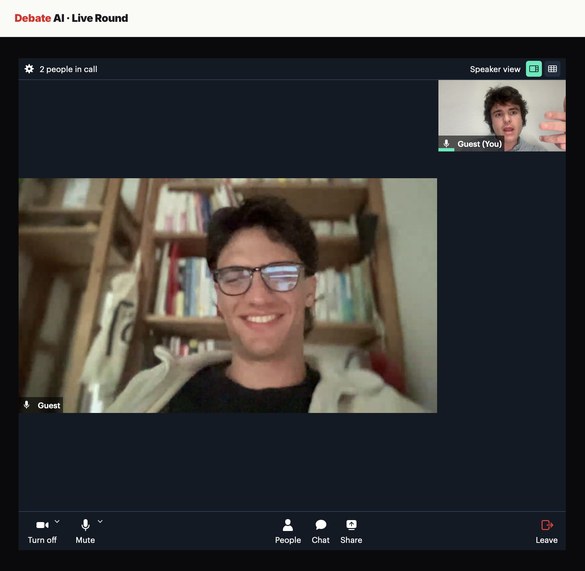
Debate the AI. Out loud. Live.
Go head-to-head against named AI opponents with real personalities, strengths, and weaknesses you can scout. Choose your format, pick your brain (Claude, GPT, Gemini, or Grok), and debate with human-sounding voice. Raise Points of Information mid-speech. Get a full judge ballot when it's over.
5 AI Personalities
Technical (framework + strategy, cold delivery), Orator (rhetoric + impact calc, shallow warrants), Aggressive (relentless pressure, drops case), Philosopher (Rawls, Kant, Foucault — but abstract), and Random (roll the dice). Each has real strengths AND real weaknesses you can learn to exploit.
4 AI Brains
Powered by Claude, GPT, Gemini, and Grok — not just one model. Each brain argues differently: Claude is surgical, GPT is creative, Gemini is fast and well-rounded, Grok is unfiltered. This multi-model approach is why the AI actually sounds like a real debater, not a chatbot.
Human Voice
6 voices from deep & authoritative to warm & friendly. Not a robot — natural speech with real pacing. Pause, skip, or raise a POI mid-speech.
Full Formats
APDA Parliamentary (the flagship competitive format) and Quick Class — the informal, accessible format built for newbies who want to argue without memorizing a rulebook. Plus British Parliamentary and Lincoln-Douglas. Real speech orders, real time limits, real prep.
Open the app. Tap any of the six tabs. Each one works independently.
2
Give it input
Enter a motion, paste a speech, type a claim. Results in under 30 seconds.
3
Iterate
Revise, ask follow-ups, copy to clipboard, or jump to another tool with the same motion.
FAQ
APDA (the flagship competitive parli format), Quick Class (the informal, beginner-friendly format — no rulebook required), British Parliamentary, World Schools, and general parliamentary.
No. Every case is generated fresh from your inputs. No recycled library.
Yes. It's a PWA. Install to your home screen on iOS or Android.
No. Prep tool, not in-round tool. In the round it's still you.
Individual plans start at $5/month. Team plans for squads and coaches at $30/month. Try 5 free requests before subscribing.
Why Debate?
The highest-leverage skill almost nobody teaches.
Debate is the one room where being wrong is free and being convincing is everything. You walk in with an opinion, you walk out with three. Someone throws an argument you've never heard, and you have eight minutes to dismantle it — no Googling, no phoning a friend, no "let me get back to you." Just you, your brain, and whatever patterns you've built. That pressure is what makes you sharp. And once the pressure's gone, the sharpness stays.
It rewires how you think about evidence. You stop asking "is this true?" and start asking "what would have to be true for this to be true — and would I bet on it?" You learn to steelman before you strike, because the fastest way to lose a round is to attack the weakest version of your opponent's case. That single habit — arguing the strongest form of what you disagree with — is the difference between people who change minds and people who just win Twitter threads.
It builds the muscle of separating performance from position. In a round you might argue Aff one debate and Neg the next on the same motion, and you have to do both honestly. You learn that "I believe X" and "the strongest case for X" are different sentences, and most of the world conflates them. Debaters don't. That's why debaters tend to become the people in a meeting who can say, "Here's the strongest version of what you just said, and here's where I think it still fails" — and everyone in the room quietly recalibrates.
It compounds into everything else. The data is embarrassingly consistent: debaters are overrepresented at Supreme Court clerkships, top law schools, policy roles, startup founders, every profession that rewards thinking under pressure. Nine of the last seventeen U.S. presidents competed in debate. It's not that debate magically manufactures success — it's that the skills debate forces on you (structured thinking, comfort with uncertainty, the ability to persuade without bullshitting) happen to be the exact skills the high-stakes parts of life run on.
And it's one of the last places you can be publicly wrong and get better at it. Modern life punishes confident mistakes — one bad tweet, one bad comment in a meeting, and you learn to stay quiet. Debate inverts that. A round is a laboratory where you're supposed to test bad ideas, get blown up on them, and come back the next round having absorbed the attack. That's how calibration actually gets built. Not by being cautious. By being wrong, on record, at speed, and iterating.
Case Gen
Builds your case from scratch with real frameworks, deep warrants, and pre-loaded blocks. Like having a research partner who never sleeps.
Round Sim
Run a full round against a trained opponent. It'll hit you with the arguments you didn't prep for so you're ready when a real team does.
Argument Map
See the whole round laid out visually. Where your case is bulletproof, where it leaks, and where the real clash is going to happen.
Judge Feedback
Get the kind of feedback you'd hear from a tough judge after a round. Specific, honest, and actually useful for next time.
I just thought, what if you could debate an AI? Not a chatbot that agrees with you, but something that actually pushes back, finds the holes in your reasoning, and forces you to defend your position. So I built it. Devil's Advocate was made with a series of cases and extensive programming to create a tool that genuinely understands argumentation, from Kantian ethics to economic tradeoffs to constitutional law. I believe that learning to argue well is one of the most underrated skills there is. It sharpens how you think about philosophy, policy, science, business, everything. Whether you're prepping for a tournament or just trying to understand both sides of an issue, having something that challenges you the way a real opponent would changes how deeply you engage with ideas. That's what this is for.
Pricing
Start free. Upgrade when you're hooked.
5 free requests, no sign-up required. Then pick a plan.
BYOK
$1/mo
Bring your own API key. Unlimited requests, you pay the AI directly.