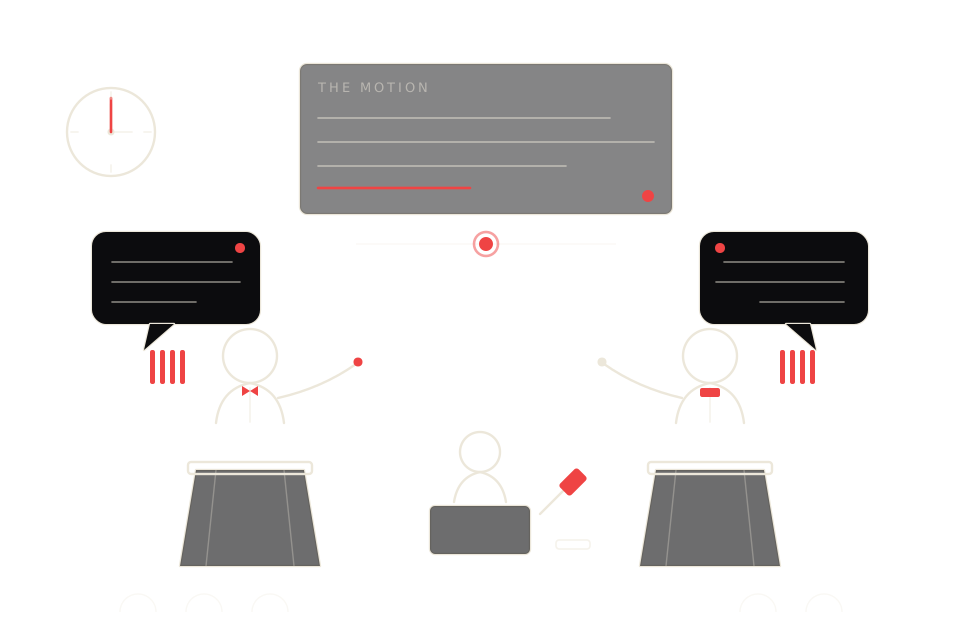
Research across four decades shows debate students outperform their peers on argumentation, reading comprehension, and college-readiness metrics, often by margins that dwarf any single academic intervention. The problem isn't whether debate works. The problem is scale. Most students never get a seat at the table because running a competitive program requires judges, coaches, and practice rounds that schools can't supply. Debate AI closes that gap.
Write an essay, fill in the blanks, answer the prompt. The whole apparatus of modern schooling trains students to reproduce correct answers. Debate is the rare class that forces students to construct arguments, defend them under time pressure, anticipate pushback, and concede what can't be saved. The evidence that this matters is overwhelming. The problem is that debate reaches a tiny fraction of students.
Controlled studies of urban debate leagues show participants gain 25% in reading comprehension and roughly half a letter grade in GPA over non-debate peers with similar baselines. The effect size exceeds most single-subject interventions at the same grade.
Debate trains students to steel-man opposing views, locate the weakest link in their own case, and concede gracefully. In an information environment where nearly everyone loses arguments by doubling down, that skill is a public good, not just a personal one.
NAUDL longitudinal data shows debate's effect on graduation, college enrollment, and GPA is strongest for low-income and first-generation students. The exact populations education reform spends most of its money trying to reach.
Every consequential profession (law, policy, medicine, science, journalism, engineering) requires constructing a case for one position, anticipating pushback, and revising in response to better evidence. Debate is the only high-school activity that trains that entire loop end-to-end.
Running a competitive program requires a coach who knows the format, a judge pool, access to practice partners, and a travel budget. Any one of those going missing breaks the whole chain. This is why most schools without a historical debate culture never start one. Not because they don't want to, but because the unit economics don't close.
debateai.com (Debate AI) is a practice-room amplifier, not a curriculum. The coach still decides what the team works on. The AI just makes the practice rep available at scale, the same way a batting cage extends a baseball team's training without replacing the hitting coach.
The same motion you'd assign for a real practice round. APDA, PF, LD, Policy, Congress, Parli, or Worlds.
Full format with real timers, POIs, cross-ex, and AI speeches that are format-native, not generic LLM filler.
Structured RFD, speaker points on the 25–30 scale, the user's best line, what they should have said, and their critical drops.
Every round exports as a flowable transcript. Use it for a 10-minute 1:1 or a team debrief. The rep did the reps; you do the teaching.
The National Association for Urban Debate Leagues has tracked it for over a decade: debate moves the needle on graduation, GPA, and college enrollment more than almost anything else schools can spend on. The gap between debate's proven impact and its actual reach isn't a funding story. It's a supply story. You can't scale a co-curricular that needs a coach, a judge pool, and a travel budget into a school that has none of those. Debate AI is the first tool that drops that bill to a per-student subscription a PTA could cover with one bake sale.
A high-schooler in a rural district, a magnet student at a school without a program, a homeschool co-op student. Anyone who has the interest and none of the infrastructure. They can start tonight.
You can't personally practice-round with every student twice a week. Debate AI handles the volume so you can focus on strategy, drill design, and the kids who need in-person attention most.
The difference between a novice who's run four practice rounds and one who's run zero is enormous, and it's almost entirely about comfort with the format. Debate AI closes that gap before the first round of competition.
Topic changes monthly in PF, each round brings new angles, and you can't always wait for a coach window. The AI is an always-on sparring partner for iterating on a case the day before a tournament.
Students who score 27.0 or higher on the academic 25-30 speaker-points scale — the median varsity speech at a real tournament — earn a tiered Debate AI credential: Novice, Varsity, Circuit, or Champion. Below 27 is participation, not a credential, and we don't issue. Each one that does get issued lives at a public verify URL. Free. Verifiable forever by anyone, no contact required.
For schools, this turns informal practice into a documentable program. Students stack credentials over time as their rounds get tighter; admissions readers and English-proficiency reviewers click a link to verify. It pairs naturally with co-curricular records, ESL portfolios, and the kind of "show me what you've done" question that comes up in college applications and first-job interviews.
Any student can try Debate AI at no cost. Schools that want to deploy it as part of their program get a flat per-school license that includes every student in the school, coach dashboards, round archives, and format-specific curriculum packs. Pricing designed to land inside a single co-curricular line item, not a new budget fight.
No. And if it were, we wouldn't ship it. Coaches do the irreplaceable human work: identifying what a student is working on, choosing drills, reading a kid's confidence, building team culture. Debate AI exists to handle the rep volume a single coach physically can't deliver to thirty students twice a week.
APDA, British Parliamentary, Asian Parliamentary, World Universities (WUDC), Lincoln-Douglas, Public Forum, Policy (CX), Congressional Debate, and Model UN. Plus a casual Quick Clash format for first-time students who don't know the jargon yet. Each one is judged by format-native criteria. LD is framework-first, Policy is tech-over-truth, PF defaults to lay accessibility.
At the end of every round the student gets a structured ballot: winner, speaker points on the 25–30 scale, decision paragraph written in real RFD voice, a key-clash summary, per-speech strengths and weaknesses, their single best line from the transcript, the line they should have said, critical arguments they dropped, and one concrete drill to practice next. Then a three-judge panel deliberates with distinct paradigms so students see how different judges read the same round.
The tool is designed as a practice partner, not a case-generator that students hand in. Coaches can review the full transcript of every round a student runs, which is exactly the opposite of a typical LLM-cheating posture. The thing it imitates is a live opponent, and no student has ever handed in a live opponent as homework.
That's actually the strongest use case. A teacher who wants to start a club but has no judge pool, no travel budget, and no feeder school across town now has a way for students to run full rounds and receive real feedback from day one. Several of our pilot schools started their entire program around the AI practice loop.
Debate AI was built by a UChicago parliamentary debater running competitive rounds since high school. Every prompt, every format rulebook, and every judge paradigm was written by someone who has actually stood at the podium. The voice banks are curated from thousands of real rounds, not scraped from the internet.
Boring credibility, deliberately. If you are evaluating Debate AI for a district or a school, this is the row you forward to your IT and legal contacts. Every claim links to the source-of-truth document; nothing here is marketing.
Student profiles, saved rounds, and ballots are stored in Google Firebase on US multi-region infrastructure. Voice audio is not retained; only the speech transcript is. Full detail in the privacy policy, sections 1 and 5.
The service is built for users 13 and older. Schools enrolling students under 13 should obtain parental consent in line with their existing COPPA/FERPA-aligned processes before account creation. Voice rounds and the learning loop only activate for signed-in accounts.
Coaches with a school team account can review every round transcript, every ballot, and every drill a student runs. This is by design — the practice room is supposed to be transparent to the coach. Students can also export their own history.
No advertising network is integrated. Student prompts, transcripts, and ballots are never sold or shared with third parties for marketing purposes. We do not authorize sub-processors to use private content to train their public foundation models.
The AI is a practice partner, not a primary source. Ballots are pedagogical feedback, not adjudicated tournament results. Where the AI cites evidence, students are expected to verify it before using it in a graded round — the same expectation a coach would set for any debater.
Students can delete their account at any time from the profile page; that wipes saved rounds, ballots, and style fingerprints from Firestore. Schools can also request a roster-level export or deletion via feedback@debateai.com. Unrated, unsaved rounds are auto-pruned after 12 months.
Sub-processors: Anthropic (Claude), OpenAI (GPT and Realtime voice), Google AI (Gemini), xAI (Grok), DeepSeek, OpenRouter (Open Lab pool), ElevenLabs, Inworld, Cartesia. Each operates under its own enterprise-grade privacy policy; the full table is in privacy policy section 3.
Debate AI is positioned as a practice partner, not a homework engine. Coaches can audit every transcript a student generated, which is the opposite of the typical "AI did the assignment" failure mode. We will refuse use cases that frame the tool as a graded-work substitute.
The coach picks drills, sets the rotation, runs the team culture. The AI handles rep volume — the thirty-rounds-a-week practice a single coach physically cannot deliver. The intended replacement is missing practice partners, not missing pedagogy.
Authentication via Google (Firebase Auth). Sensitive endpoints are gated by Firebase App Check and rate-limited per IP and per account. Payments, if and when activated, go through Stripe; the platform never sees card numbers or bank credentials.