Debate it is a voice-first argumentation platform. Users pick a motion, choose a side, and argue an AI opponent in timed rounds across ten debate formats. A written judge ballot follows each round.

Format

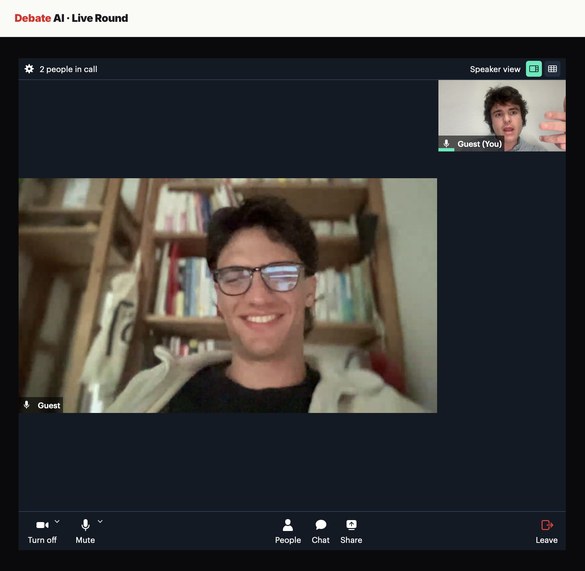
The user picks (or generates) a motion and chooses a side. The AI takes the opposing position and replies under a clock. In voice rounds, the user speaks aloud and the system returns live counterarguments and Points of Information until the timer expires.

Voice rounds run over the OpenAI Realtime audio path. Typed rounds route through one of six language models: Claude, GPT, Gemini, Grok, DeepSeek, or Open Lab.

Supported Formats

  • Asian Parliamentary
  • World Schools (WSDC)
  • British Parliamentary
  • Public Forum
  • American Parliamentary (APDA)
  • Lincoln-Douglas
  • Policy
  • Congressional Debate
  • Model UN
  • Quick Clash (casual)

A separate oral-exam drill uses the same engine for academic defense (explaining an essay) and interview prep.

Judging

After the final speech, the platform writes a ballot in the style of a competitive judge. It weighs arguments, responsiveness, clarity, evidence, and strategic weighing, then names a winner with a short Reason for Decision. In panel mode, three AI judges write independently, and a consensus banner sits above their reasoning.

Goals

Where the platform is headed in the next year. These are ambitions, not announcements; the day-to-day product still does the three jobs at the bottom of this section.

  • Host a flagship online tournament. Open entry from any school in any country. AI judges the prelim rounds; top human judges call the elimination rounds. The aim is a real bid-equivalent event where the only thing between a kid in a Tier-3 city and a competitive global circuit is a working phone.
  • An ambassador on every major circuit. Student leads in India, the UK, the US, Singapore, the Philippines, Kenya, Australia, and the Indian school federations. Their job is to bring the AI into clubs without a varsity team, and to keep the format-specific voice honest with feedback from real rounds.
  • Bridge the language gap. A Hindi-medium debater in Lucknow can drill English-medium WSDC against the AI before flying to a tournament in Singapore. The engine runs in 14 languages so circuits stop being walled off by language of instruction.
  • Bring varsity-grade prep where there is no varsity program. Most of the world does not have a debate coach. The platform replaces the layer most schools cannot afford to hire, so the talent that decides the next generation of public argument is not gated by geography.
  • Make oral exams the test schools trust again. Written homework is fakeable now. Viva mode exists so defending your reasoning out loud becomes the assessment that survives the AI moment.
  • Build the largest open RFD library in debate. Every rated round feeds the nightly distillation that improves the next round's judge. Over time, the corpus becomes the teaching artifact that a textbook never quite was.

The three jobs the platform does today.

  • Tournament prep. Drill the format you compete in (Asian Parli, WSDC, BP, APDA, Policy, LD, PF) between rounds. Format-specific motion banks, format-accurate AI delivery, judge ballots in the register competitive judges actually write. The AI takes the side you're not arguing so you can stress-test cases before bid weekend.
  • Cross-language practice. Voice and typed rounds run in 14 languages, including Hindi, Mandarin, Spanish, French, Arabic, and Bengali. The AI listens, replies, and writes the Reason for Decision in the language you pick. Useful for non-English national circuits and for debaters preparing for international rounds in a second language.
  • Solo practice without a partner. Most debate skills need someone to argue against. The AI fills that gap for the days you don't have a teammate or a tournament: a motion drops, the AI takes the other side, the round runs.

Use Cases

Primarily competitive debaters at the high-school and university levels. The same engine drills any role that runs on structured argument, evidence on a clock, and live pushback.

  • Pre-law and law school applicants. A debate flow is a legal brief; cross-ex is direct examination; rebuttals are appellate work. Notable: Stephen Breyer, Ted Cruz, countless circuit-court clerks.
  • Management consulting candidates. A McKinsey, BCG, or Bain case interview is a five-minute parli round: resolution, framework, three impacts, pushback, sharpened conclusion. Top firms over-recruit from APDA, BP, and Worlds programs.
  • Politics and policy staff. Bill Clinton, Barack Obama, and Pete Buttigieg debated. The Oxford Union president list reads like a UK Cabinet roster. State AGs, congressional staff, and campaign managers over-index for ex-debaters.
  • Investment banking and private equity. The analyst-to-MD arc is structured argument with a clock. Goldman, Morgan Stanley, KKR, and Blackstone hire from debate programs because the LP call and the IC presentation are adversarial argument under deadline.
  • Tech founders. A seed pitch is a five-minute case; investor Q&A is cross-ex; board meetings are whip speeches. YC partners over-index for ex-debater founders because conviction under pressure is the founder skill, not the slide deck.
  • Journalism, policy research, academia. Op-ed columnists, think-tank fellows, and academic philosophers disproportionately have debate backgrounds. Brookings, RAND, AEI, Cato, and CFR hire heavily here.
  • Oral exam prep. AI is making written work easy to fake, so schools are bringing oral exams back as the test they can trust. The viva mode drills that skill: defend your reasoning out loud, with an examiner that pushes on the weak link until the timer expires.
  • Lawyers drilling openings and cross-examination, sales teams practicing objection handling, and anyone rehearsing rhetoric or real-time decision-making under pressure.

The jobs above pay well because they reward the same five skills in different uniforms: structured argument, evidence on a clock, cross-examination, adapting when the room pushes back, and closing under time pressure. Debate practices all five every round.